

- English
- Italian
Friday the 13th, America’s Sky Went Dark . Was it an Accident, a Test, or Cover-Up?
One router. 20,000 disrupted flights. And a country asking: how can that be the whole story?
What happened – told in 60 seconds
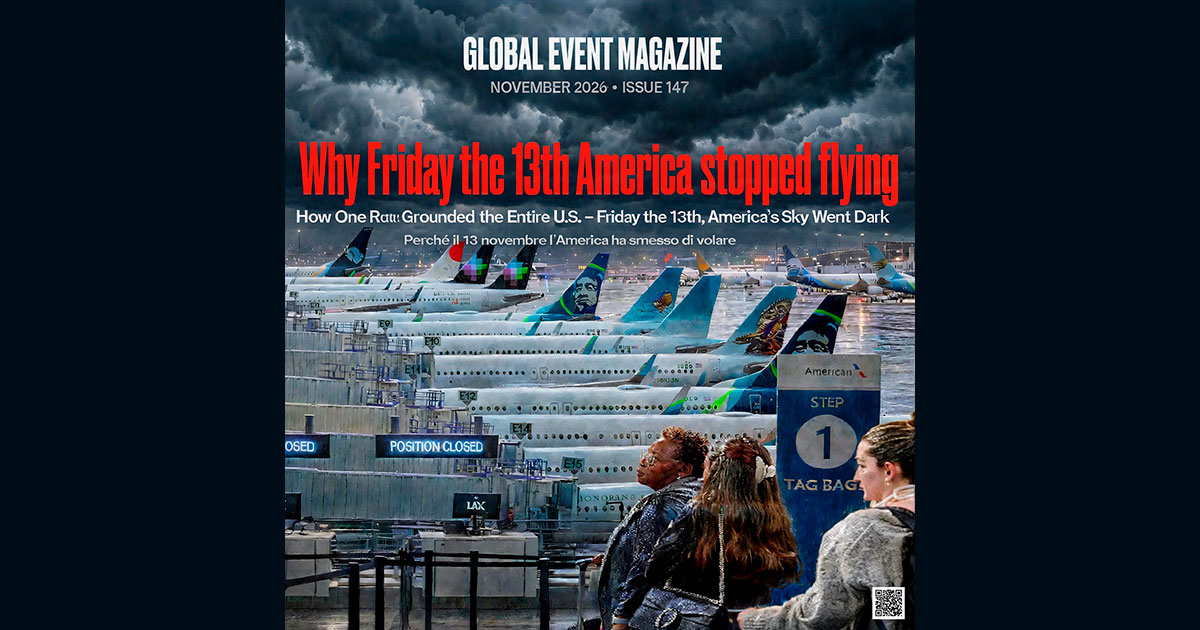
On Friday, 13 November 2026, at around 3:54 p.m. ET, the FAA issued a nationwide ground stop.
Every departing flight in the U.S. stopped. Planes already in the air were landed. For almost five hours, until 8:15 p.m. ET, America did not fly.
It was the longest nationwide ground stop in 25 years, and the first on this scale since 9/11.
Friday alone: 6,600+ flights cancelled, 8,600+ delayed. Saturday added 3,700+ more cancellations as the system tried to recover. In total, officials say more than 20,000 flights were disrupted since Friday.
The official reason
Transportation Secretary Sean Duffy said on Saturday that the cause was routine maintenance that went wrong.
Contractor L3Harris was at a remote FAA site replacing old copper wire with fiber-optic cable – part of a decades-long modernization of the air traffic control network.
During that work, a router being replaced began flooding other routers on the system, reportedly with about 1,000 logon attempts every four to five seconds, until the network was overloaded.
Duffy’s own words:
“Our switches, our routers actually got overloaded with data. They started to give us inconsistency in the data from those routers, and because of that we shut the system down.”
FAA Administrator Bryan Bedford said there was no evidence it was a cyberattack or an AI failure. The FAA said flights should be back to normal by the end of Sunday.
Investigators still have not decided: was it a faulty router, or a faulty installation? Duffy said the FAA is still working out whether it was “incompetence” by the contractor or bad equipment.
That gap between “we know what happened” and “we don’t know why it happened” – is where the mystery lives.
Why it felt like a mystery, not an accident
a) The timing was too perfect to ignore
Friday the 13th.
The day before, Microsoft 365 had suffered a massive global outage. Outlook, Teams, Copilot and SharePoint went down for users in 74 countries, starting Thursday 12 November. Microsoft later attributed it to a flaw introduced during a network capacity upgrade, not a cyberattack.
Then on Friday, the planes stopped.
Officials insist there is no connection. Homeland Security Secretary Mullin dismissed any link between the FAA outage and Microsoft. Microsoft also said it had no indication the ground stop was related to its outage.
But for the public, two national systems failing within 24 hours did not feel like coincidence.
b) The explanation kept changing
Friday: “temporary telecommunications outage” affecting control centers.
Friday night at the White House: aging switches and routers “overloaded.”
Saturday: a specific router, at a specific remote site, during copper-to-fiber work.
Each version was more precise and that made people ask why the first version was so vague.
c) The location was never named
Duffy repeatedly said “a remote location.” He never named the site. For a story about national infrastructure, that single missing detail became the biggest mystery of all.
d) Even controllers reportedly didn’t buy it
Journalist Anna Giaritelli reported that around 60 air traffic controllers did not believe Duffy’s reasoning about the outage. No independent technical after-action report establishing the root cause had been located as of November 14.
That doesn’t prove a cover-up. It proves the official story has not yet been proven with documents.
e) The system was supposed to have backups
How does one router at one remote site take down 22+ centers and every airport in the country?
That is the real infrastructure mystery. The U.S. system still mixes old analog/time-division equipment with new IP equipment. When the new router flooded the network, controllers lost consistent data on the radio frequencies used to talk to aircraft. Without reliable communication, the only safe choice was to ground everything.
In other words: the system didn’t fail because it was weak in one place. It failed because it was interconnected everywhere.
The theories that filled the vacuum
On social media, within hours, three main theories took over:
1. The Blackout Test
A viral video claimed the grounding was “not what officials say, but rather ‘a test’ to see how the population would respond to a nationwide blackout,” linked to an imminent grid-down event and a “shadow government,” urging viewers to stockpile food and water for three months.
2. Cyber Warfare
Another viral post claimed the grounding was “100% cyber warfare” on Friday the 13th. Others claimed America “just got hacked” because of a radar outage.
3. The AI / Centralization Plot
Another viral theory cited a September 2026 GAO audit and claimed the grounding was engineered to justify replacing decentralized regional systems with a single unified digital grid by 2028.
There is no evidence for any of these. Officials have explicitly said there is no indication of a cyberattack or rogue AI, and no confirmed connection to Microsoft.
But theories spread because the official timeline left a vacuum for almost 24 hours and because Friday the 13th + Microsoft down + planes down is a story the brain wants to connect.
So: mystery or just old wires?
Both.
The reason is plausible: An old system, a routine upgrade, a router that flooded the network, a safety – first ground stop.
The mystery is real: Why was maintenance that could cascade nationally allowed without a stronger failsafe? Why was the site not named? Why is there still no final technical report? And why did controllers, who live in this system every day, reportedly not believe the first explanation?
That is the story to keep following – not whether it was a secret test, but whether America’s air traffic system is now so interconnected that one small failure can ground a continent.
America didn’t lose its sky to an enemy, or to a storm, or to a secret test. It lost it to a single wire, in a single room, on a Friday the 13th and that may be the most frightening explanation of all.
Venerdì 13, il cielo d’America si è oscurato. Incidente, test o insabbiamento?
Un router. 20.000 voli interrotti. E un paese che si chiede: come può essere tutta qui la storia?
Cos’è successo – raccontato in 60 secondi
Venerdì 13 novembre 2026, intorno alle 15:54 ET, la FAA ha emesso uno stop a terra a livello nazionale.
Ogni volo in partenza negli Stati Uniti si è fermato. Gli aerei già in volo sono stati fatti atterrare. Per quasi cinque ore, fino alle 20:15 ET, l’America non ha volato.
È stato lo stop a terra nazionale più lungo in 25 anni, e il primo su questa scala dai tempi dell’11 settembre.
Solo venerdì: oltre 6.600 voli cancellati, oltre 8.600 in ritardo. Sabato si sono aggiunte altre 3.700+ cancellazioni mentre il sistema cercava di riprendersi. In totale, secondo i funzionari, più di 20.000 voli sono stati interrotti da venerdì.
La ragione ufficiale
Il Segretario ai Trasporti Sean Duffy ha dichiarato sabato che la causa è stata una manutenzione di routine andata male.
Il contraente L3Harris stava lavorando presso un sito remoto della FAA, sostituendo vecchi cavi in rame con cavi in fibra ottica – parte di una modernizzazione decennale della rete di controllo del traffico aereo.
Durante quel lavoro, un router in fase di sostituzione ha iniziato a inondare gli altri router del sistema, presumibilmente con circa 1.000 tentativi di accesso ogni quattro-cinque secondi, finché la rete non è stata sovraccaricata.
Le parole stesse di Duffy:
“I nostri switch, i nostri router si sono effettivamente sovraccaricati di dati. Hanno iniziato a darci incoerenza nei dati provenienti da quei router, e per questo abbiamo spento il sistema.”
L’amministratore della FAA Bryan Bedford ha dichiarato che non c’erano prove di un attacco informatico o di un guasto dell’IA. La FAA ha affermato che i voli sarebbero dovuti tornare alla normalità entro la fine di domenica.
Gli investigatori non hanno ancora deciso: è stato un router difettoso o un’installazione difettosa? Duffy ha detto che la FAA sta ancora cercando di capire se si sia trattato di “incompetenza” del contraente o di apparecchiature difettose.
Quel divario tra “sappiamo cosa è successo” e “non sappiamo perché sia successo” – è lì che vive il mistero.
Perché è sembrato un mistero, non un incidente
a) Il tempismo era troppo perfetto per essere ignorato
Venerdì 13.
Il giorno prima, Microsoft 365 aveva subito una massiccia interruzione globale. Outlook, Teams, Copilot e SharePoint erano andati giù per utenti in 74 paesi, a partire da giovedì 12 novembre. Microsoft ha poi attribuito la colpa a un difetto introdotto durante un aggiornamento della capacità di rete, non a un attacco informatico.
Poi, venerdì, gli aerei si sono fermati.
I funzionari insistono che non c’è alcun collegamento. Il Segretario alla Sicurezza Interna Mullin ha respinto qualsiasi legame tra l’interruzione della FAA e Microsoft. Anche Microsoft ha dichiarato di non avere indicazioni che lo stop a terra fosse legato alla propria interruzione.
Ma per il pubblico, due sistemi nazionali che falliscono nell’arco di 24 ore non sembravano una coincidenza.
b) La spiegazione continuava a cambiare
Venerdì: “interruzione temporanea delle telecomunicazioni” che colpiva i centri di controllo.
Venerdì sera alla Casa Bianca: switch e router obsoleti “sovraccarichi”.
Sabato: un router specifico, in un sito remoto specifico, durante i lavori di conversione da rame a fibra.
Ogni versione era più precisa, e questo ha fatto chiedere alla gente perché la prima versione fosse così vaga.
c) La posizione non è mai stata nominata
Duffy ha ripetutamente detto “una posizione remota”. Non ha mai nominato il sito. Per una storia sulle infrastrutture nazionali, quel singolo dettaglio mancante è diventato il più grande mistero di tutti.
d) A quanto pare, nemmeno i controllori ci credevano
La giornalista Anna Giaritelli ha riportato che circa 60 controllori del traffico aereo non credevano al ragionamento di Duffy sull’interruzione. Nessun rapporto tecnico indipendente post-evento che stabilisse la causa principale era stato individuato al 14 novembre.
Questo non prova un insabbiamento. Prova che la versione ufficiale non è ancora stata dimostrata con documenti.
e) Il sistema avrebbe dovuto avere backup
Come fa un router in un singolo sito remoto a mandare giù 22+ centri e ogni aeroporto del paese?
Questo è il vero mistero infrastrutturale. Il sistema statunitense mescola ancora vecchie apparecchiature analogiche/a divisione di tempo con nuove apparecchiature IP. Quando il nuovo router ha inondato la rete, i controllori hanno perso dati coerenti sulle frequenze radio utilizzate per comunicare con gli aerei. Senza comunicazioni affidabili, l’unica scelta sicura era bloccare tutto a terra.
In altre parole: il sistema non è fallito perché era debole in un punto. È fallito perché era interconnesso ovunque.
Le teorie che hanno riempito il vuoto
Sui social media, nel giro di poche ore, hanno preso piede tre teorie principali:
- Il test del blackout
Un video virale sosteneva che il blocco a terra “non era quello che dicono i funzionari, ma piuttosto ‘un test’ per vedere come la popolazione avrebbe reagito a un blackout nazionale”, collegato a un imminente evento di collasso della rete elettrica e a un “governo ombra”, esortando gli spettatori a fare scorte di cibo e acqua per tre mesi. - Guerra informatica
Un altro post virale sosteneva che il blocco a terra era “guerra informatica al 100%” di venerdì 13. Altri sostenevano che l’America “era appena stata hackerata” a causa di un’interruzione del radar. - Il complotto dell’IA / centralizzazione
Un’altra teoria virale citava un audit del GAO di settembre 2026 e sosteneva che il blocco a terra era stato ingegnerizzato per giustificare la sostituzione dei sistemi regionali decentralizzati con un’unica rete digitale unificata entro il 2028.
Non ci sono prove per nessuna di queste. I funzionari hanno esplicitamente dichiarato che non ci sono indicazioni di un attacco informatico o di un’IA ribelle, e nessun collegamento confermato a Microsoft.
Ma le teorie si diffondono perché la cronologia ufficiale ha lasciato un vuoto per quasi 24 ore e perché venerdì 13 + Microsoft giù + aerei giù è una storia che il cervello vuole collegare.
Quindi: mistero o solo vecchi cavi?
Entrambi.
La ragione è plausibile: un vecchio sistema, un aggiornamento di routine, un router che ha inondato la rete, uno stop a terra per sicurezza.
Il mistero è reale: perché è stato permesso che una manutenzione in grado di propagarsi a cascata a livello nazionale avvenisse senza un failsafe più robusto? Perché il sito non è stato nominato? Perché non c’è ancora un rapporto tecnico finale? E perché i controllori, che vivono in questo sistema ogni giorno, a quanto pare non credevano alla prima spiegazione?
Questa è la storia da seguire – non se sia stato un test segreto, ma se il sistema di traffico aereo americano sia ormai così interconnesso che un piccolo guasto può bloccare un continente.
L’America non ha perso il suo cielo per colpa di un nemico, né di una tempesta, né di un test segreto. L’ha perso per un singolo cavo, in una singola stanza, di venerdì 13 – e questa potrebbe essere la spiegazione più spaventosa di tutte.