- English
- Italian
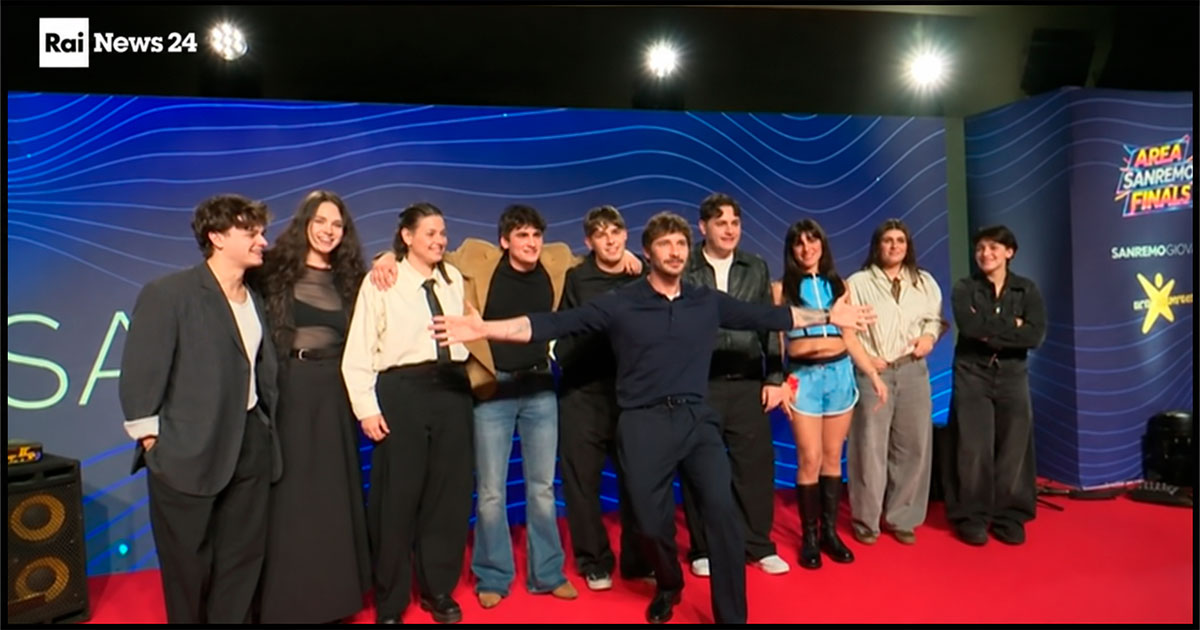
Florinda, Petit, Santamarea, Lens, Nausica e l’Inganno and Primogenito are the six finalists of Sarà Sanremo. On December 11, only one of them will earn a place in the Sanremo 2027 lineup. Behind these names, however, are six very different musical journeys: from conservatory training to talent shows, from independent music to major labels, from suburban songwriting to alt-pop.
SANREMO – Six artists, six stories and only one spot available.
Sanremo Giovani 2026 is entering its decisive stage with a format that dramatically raises the stakes of the final: Florinda, Petit, Santamarea, Lens, Nausica e l’Inganno and Primogenito are not competing in a separate category reserved for newcomers. On December 11, one of them will move directly into the 24-artist main lineup of the 2027 Sanremo Music Festival.
At the Teatro del Casinò, live in prime time on Rai 1, one artist will earn the right to move straight from the young artists’ selection to the main stage of the Ariston. That same night, Stefano De Martino will also announce the other 23 artists chosen for the Festival.
But reducing the final to a competition among six names would miss the point.
These six artists almost unintentionally represent six very different ways of building a music career in Italy today.
Florinda: Naples, Piano and a Language That Becomes Identity
Florinda comes from Naples with a musical background that did not begin in front of a television camera. Born in 2000 and trained in piano at Naples’ San Pietro a Majella Conservatory, she has developed a musical language that brings together classical training, pop, R&B and her Neapolitan roots. She reached Sanremo Giovani with “Senza ’E Te.”
She is one of the most interesting artists in the lineup precisely because Neapolitan does not feel like a folkloric element added after the fact: it is part of the writing itself.
Her music brings together piano, Naples’ melodic tradition and a distinctly contemporary awareness of international production. She was also selected for Amazon Music Breakthrough, evidence that the music industry had already begun paying attention to her before her Sanremo run.
Florinda represents one of the strongest trends in recent Italian music: returning to the language of one’s own territory without giving up a sound capable of traveling far beyond it.
Petit: From Television to the Test of Artistic Identity
If Florinda arrives with conservatory training behind her, Petit brings something no other finalist possesses to the same degree: an audience already waiting for him.
Salvatore Moccia, a Rome-born artist from the class of 2005, became widely known through Amici 23, where he reached the singing final. His career did not stop with the talent show: Tornerai was certified gold and Mammamì platinum. In 2025, he had already made an attempt at Sanremo Giovani with Un bel casino, reaching the semifinals. Now he returns with “SEI TU.”
He is probably the finalist most familiar with the language of major television entertainment.
For Petit, December 11 will not simply be about introducing himself to the public. He will have to prove that behind the popularity he built on television lies a musical personality distinctive enough to make the leap into Sanremo’s main lineup.
Santamarea: A Band That Arrives With a Journey Already Behind It
Then there are Santamarea, and here the story changes again.
The Sicilian project has already moved through stages and circuits more closely associated with the traditional development of a band than with the logic of a talent show. They won Musicultura in 2023, performed at MI AMI and Brussels’ Fifty Lab, and in 2026 released their debut album, Anime Storte.
Their territory is expansive, physical alt-pop built around guitars, synths, percussion and a strong collective dimension. Their musical reference points include Florence + The Machine, Arcade Fire and Alt-J. At Sanremo Giovani, they are competing with “Tutto questo mare dentro.”
Among the six finalists, they are probably the act with the strongest live-band identity.
If they can transfer that energy into the tightly controlled format of the competition, they could emerge as one of the final’s most musically distinctive acts.
Lens: The Independent Artist Without a Major Machine Behind Him
If there is an outsider story in this final, it belongs to Lens.
Behind the stage name is Francesco Pelliccioni, a Bologna singer-songwriter born in 2000. He is the only finalist identified as an independent artist.
His relationship with music is also relatively recent. Pelliccioni says he began writing seriously after a painful breakup in 2023. His first single, Biondocenere, arrived in 2024, followed by Sai and, in December 2025, the EP TU COME ME. He describes himself as a “misplaced pop-romantic singer-songwriter.”
In a system where many young artists reach major selections already surrounded by labels, press offices, management teams and promotional structures, Lens’ presence carries a particular significance.
It means reaching the same door by taking a narrower road.
Nausica e l’Inganno: The Harp Outside Its Usual Setting
Nausica e l’Inganno brings one of the most unusual sonic identities to the final.
The project centers on Catania musician Giordana Petralia, whom television audiences first discovered as a very young contestant on X Factor in 2019, where she reached the sixth live show as part of Sfera Ebbasta’s team. Even then, her artistic image was immediately recognizable because of an instrument rarely associated with television pop: the harp.
This is not Petralia’s first experience in the Sanremo universe. In 2023, she won Area Sanremo and reached Sanremo Giovani with Favole, also receiving the De Scalzi Award. She now returns with a new artistic identity, Nausica e l’Inganno, which Area Sanremo lists as a duo.
The harp remains a defining element, but the question is no longer simply the novelty of placing a classical instrument inside pop music. The real question is whether that sound can become a language, rather than merely a visual or stylistic device.
Primogenito: The Suburbs Start Writing Songs Again
Finally, there is Primogenito, the stage name of Gabriele Tosti.
Born in Rome in 2004, he comes from a singer-songwriter tradition that has already begun to define its own narrative world. In 2026, he released the EP “Affogare in acque amiche” through EMI Records Italy/Universal, a project that brings together suburban life, relationships, discomfort, irony and deliberately unconventional songwriting.
Over the course of the year, he also performed at Rome’s May Day Concert and at MI AMI, building his career primarily through songs and live performances.
His strength lies in the writing.
Primogenito belongs to a new generation of singer-songwriters who are not trying to imitate the classic Italian cantautori, but who have recovered their need to tell stories about people, places and small everyday failures.
It is urban writing without needing to become “urban” music.
Six Finalists, But Not Six Beginners Starting From the Same Place
This is where the December 11 final becomes musically interesting.
Petit arrives from television and record certifications. Florinda from conservatory training and a search for her own roots. Santamarea from live performance and an already released album. Lens arrives as an independent artist. Nausica e l’Inganno brings an instrument and a sonic history that are difficult to confuse with anyone else’s. Primogenito comes from a new generation of Italian songwriting.
Grouping all of them under the single label of “young artists” therefore tells us very little.
They are not starting from the same line. They do not have the same audience, the same experience, the same record-industry support or even the same idea of what music should be.
That is the most interesting aspect of this year’s selection. Sanremo Giovani is not simply looking for a new name: it is deciding which of these six ideas of what an artist can be is ready to enter the room reserved for Sanremo’s main contenders.
December 11 Is About More Than Winning a Final
The six artists will be judged by the Music Commission chaired by Stefano De Martino and made up of Noemi, Fabio Volo, Carlo Pastore, Maestro Pino Perris, Ema Stokholma and Claudio Fasulo. The final will air on December 11 in prime time on Rai 1 from Sanremo’s Teatro del Casinò.
The stakes are enormous.
Under the new rules, the reassuring distance between “young artists” and the established names no longer exists: the winner will move directly into the group of 24 artists who will compete on the Ariston stage from February 16 through 20, 2027.
Only one of them.
The other five will return to their respective paths with far greater visibility, certainly, but without that coveted spot.
It is a tough formula, perhaps even a ruthless one. But it turns December 11 into a genuine night of music rather than a simple showcase ahead of the Festival.
And when the lights go down at the Casinò, the winner’s name will not simply tell us who is going to Sanremo. It will also tell us which vision of Italy’s new music Stefano De Martino and his Commission have chosen to bring directly into the Festival’s main lineup.
Florinda, Petit, Santamarea, Lens, Nausica e l’Inganno e Primogenito sono i sei finalisti di Sarà Sanremo. L’11 dicembre uno soltanto entrerà nel cast di Sanremo 2027. Dietro i nomi, però, ci sono sei percorsi musicali molto diversi: dal Conservatorio ai talent, dall’indipendenza alle major, dal cantautorato di periferia all’alt-pop.
Florinda, Petit, Santamarea, Lens, Nausica e l’Inganno e Primogenito sono i sei finalisti di Sarà Sanremo. L’11 dicembre uno soltanto entrerà nel cast di Sanremo 2027. Dietro i nomi, però, ci sono sei percorsi musicali molto diversi: dal Conservatorio ai talent, dall’indipendenza alle major, dal cantautorato di periferia all’alt-pop.
SANREMO – Sei artisti, sei storie e un solo posto disponibile.
Sanremo Giovani 2026 arriva alla sua fase decisiva con una formula che cambia radicalmente il peso della finale: Florinda, Petit, Santamarea, Lens, Nausica e l’Inganno e Primogenito non stanno concorrendo per una categoria separata riservata alle nuove proposte. Uno di loro, l’11 dicembre, entrerà direttamente tra i 24 Campioni del Festival di Sanremo 2027.
Al Teatro del Casinò, in prima serata su Rai 1, si deciderà chi avrà il diritto di passare senza anticamere dalla selezione giovanile al palco principale dell’Ariston. Nella stessa serata Stefano De Martino annuncerà anche gli altri 23 Campioni scelti per il Festival.
Ma sarebbe riduttivo leggere la finale soltanto come una gara tra sei nomi.
Questi sei artisti raccontano, quasi involontariamente, sei modi molto diversi di costruire oggi una carriera musicale in Italia.
Florinda: Napoli, pianoforte e una lingua che diventa identità
Florinda arriva da Napoli e porta con sé una formazione che non nasce davanti a una telecamera. Classe 2000, diplomata in pianoforte al Conservatorio San Pietro a Majella, ha costruito il proprio linguaggio mettendo insieme studio classico, pop, R&B e radici partenopee. A Sanremo Giovani è arrivata con “Senza ’E Te”.
È uno dei profili più interessanti proprio perché il napoletano non appare come una decorazione folkloristica aggiunta a posteriori, è parte della scrittura.
Nel suo percorso convivono il pianoforte, la cultura melodica della città e un ascolto molto contemporaneo della produzione internazionale. È stata anche selezionata per il progetto Amazon Music Breakthrough, segnale di un’attenzione discografica già precedente alla corsa sanremese.
Florinda rappresenta una delle tendenze più forti della musica italiana recente: tornare alla lingua del proprio territorio senza rinunciare a un suono capace di viaggiare fuori da quel territorio.
Petit: dalla televisione alla prova dell’identità artistica
Se Florinda arriva con il bagaglio del Conservatorio, Petit arriva con qualcosa che nessun altro finalista possiede nella stessa misura: un pubblico già costruito.
Salvatore Moccia, romano classe 2005, è diventato noto attraverso Amici 23, dove ha raggiunto la finale della categoria canto. Il percorso successivo non si è fermato al talent: Tornerai è stato certificato disco d’oro e Mammamì disco di platino. Nel 2025 aveva già tentato Sanremo Giovani con Un bel casino, fermandosi in semifinale. Ora torna con “SEI TU”.
È probabilmente il concorrente che conosce meglio il linguaggio del grande spettacolo televisivo.
Per Petit l’11 dicembre non si tratterà semplicemente di farsi conoscere: dovrà dimostrare che dietro la popolarità conquistata in televisione esiste una personalità musicale abbastanza riconoscibile da reggere il salto verso i Campioni.
Santamarea: quando una band arriva con un percorso già alle spalle
Poi ci sono i Santamarea, e qui il discorso cambia ancora.
Il progetto siciliano ha già attraversato palchi e circuiti che appartengono più alla costruzione tradizionale di una band che alla logica del talent. Hanno vinto Musicultura nel 2023, hanno suonato al MI AMI e al Fifty Lab di Bruxelles e nel 2026 hanno pubblicato l’album d’esordio Anime Storte.
Il loro territorio è un alt-pop ampio, fisico, costruito su chitarre, synth, percussioni e una forte dimensione corale. Tra le coordinate musicali indicate nel loro percorso compaiono Florence + The Machine, Arcade Fire e Alt-J. A Sanremo Giovani portano “Tutto questo mare dentro”.
Tra i sei sono probabilmente quelli che arrivano con la dimensione di gruppo live più evidente.
Se riusciranno a trasferire quella forza dentro la forma strettissima della gara, potrebbero rappresentare una delle proposte musicalmente più riconoscibili della finale.
Lens: l’indipendente che arriva senza una grande macchina alle spalle
Se c’è una storia da outsider, è quella di Lens.
Dietro il nome d’arte c’è Francesco Pelliccioni, cantautore bolognese classe 2000. È l’unico indicato come indipendente.
La sua relazione con la musica, inoltre, è relativamente recente. Pelliccioni racconta di aver cominciato a scrivere seriamente dopo una forte delusione sentimentale nel 2023. Nel 2024 è arrivato il primo singolo, Biondocenere, quindi Sai e, nel dicembre 2025, l’EP TU COME ME. Lui stesso si definisce un “cantautore pop-romantico fuoriposto”.
In un sistema nel quale molti giovani arrivano alle selezioni già accompagnati da etichette, uffici stampa, management e strutture promozionali, la presenza di Lens assume un significato particolare.
Significa arrivare alla stessa porta attraverso una strada più stretta.
Nausica e l’Inganno: l’arpa fuori dal suo luogo abituale
Nausica e l’Inganno porta invece una delle identità sonore più insolite della finale.
Il progetto fa capo alla catanese Giordana Petralia, musicista che il pubblico televisivo aveva conosciuto giovanissima a X Factor nel 2019, dove era arrivata fino al sesto Live nella squadra di Sfera Ebbasta. La sua immagine era già allora immediatamente riconoscibile per uno strumento poco frequentato dal pop televisivo: l’arpa.
Petralia non arriva per la prima volta nell’universo sanremese. Nel 2023 aveva vinto Area Sanremo e raggiunto Sanremo Giovani con Favole, ricevendo anche il Premio De Scalzi. Oggi torna con una nuova identità progettuale, Nausica e l’Inganno, che Area Sanremo registra come duo.
L’arpa resta un segno distintivo, ma il punto non è più soltanto la curiosità dello strumento classico inserito nel pop. La domanda è se quel suono possa diventare linguaggio, non semplice elemento scenografico.
Primogenito: la periferia torna a scrivere canzoni
Infine c’è Primogenito, nome d’arte di Gabriele Tosti.
Romano, classe 2004, arriva da un percorso cantautorale che ha già cominciato a definire un proprio mondo narrativo. Nel 2026 ha pubblicato per EMI Records Italy/Universal l’EP “Affogare in acque amiche”, un progetto che mette insieme periferia, relazioni, disagio, ironia e una scrittura volutamente obliqua.
Nel corso dell’anno è passato anche dal palco del Concertone del Primo Maggio e dal MI AMI, costruendo quindi il proprio percorso soprattutto attraverso canzoni e concerti.
La sua forza sta nella scrittura.
Primogenito appartiene a quella nuova generazione di cantautori che non tenta di imitare il cantautorato classico, ma ne recupera la necessità di raccontare persone, luoghi e piccoli fallimenti quotidiani.
È una scrittura urbana senza bisogno di diventare urban.
Sei finalisti, ma non sei esordienti allo stesso punto
È qui che la finale dell’11 dicembre diventa musicalmente interessante.
Petit arriva dalla televisione e dalle certificazioni. Florinda dal Conservatorio e da una ricerca sulle proprie radici. I Santamarea dal live e da un album già pubblicato. Lens arriva da indipendente. Nausica e l’Inganno porta uno strumento e una storia sonora difficili da confondere con altri. Primogenito arriva dalla nuova canzone d’autore.
Metterli tutti sotto la stessa etichetta di “giovani” rischia quindi di raccontare poco.
Non partono dalla stessa linea. Non hanno lo stesso pubblico, la stessa esperienza, lo stesso apparato discografico né la stessa idea di musica.
Questo è il punto più interessante della selezione. Sanremo Giovani, quest’anno, non sta semplicemente cercando un nome nuovo, sta decidendo quale di queste sei idee di artista sia pronta a entrare direttamente nella stanza dei Campioni.
L’11 dicembre non si vince soltanto una finale
A giudicare i sei sarà la Commissione Musicale presieduta da Stefano De Martino e composta da Noemi, Fabio Volo, Carlo Pastore, il maestro Pino Perris, Ema Stokholma e Claudio Fasulo. La finale andrà in onda l’11 dicembre in prima serata su Rai 1 dal Teatro del Casinò di Sanremo.
La posta in gioco è enorme.
Con il nuovo regolamento non esiste più la rassicurante distanza tra “giovani” e “grandi”: il vincitore entrerà direttamente nel gruppo dei 24 Campioni che saliranno sul palco dell’Ariston dal 16 al 20 febbraio 2027.
Uno soltanto. Gli altri cinque torneranno al proprio percorso con molta più visibilità, certamente, ma senza quel posto.
È una formula severa, forse persino spietata. Ma rende l’11 dicembre una vera serata musicale, non una semplice passerella in attesa del Festival.
E quando si spegneranno le luci del Casinò, il nome del vincitore non dirà soltanto chi andrà a Sanremo. Dirà anche quale idea di nuova musica italiana Stefano De Martino e la sua Commissione hanno scelto di portare direttamente tra i Campioni.