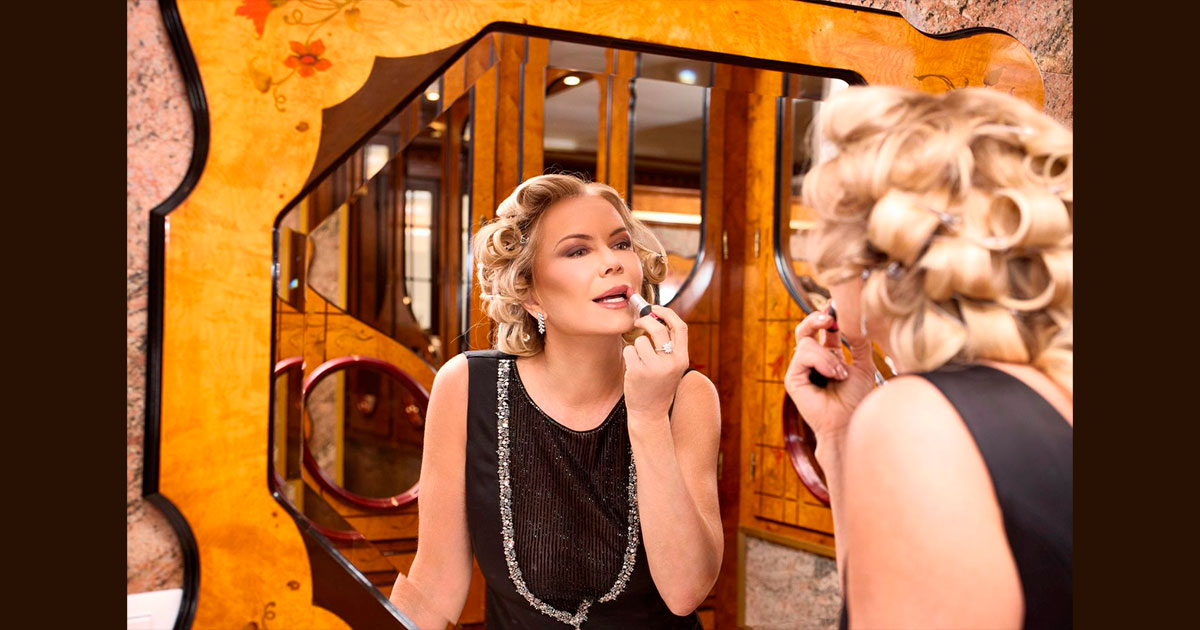


Make-up: MKS Make Up
Key Artist: Sara Bergaglio
- English
- Italian
At Milan Fashion Week, Huizhou Zhao unveils the Spring/Summer 2027 collection, starting from an ancient symbol—the circular fan—to explore memory, female identity and the transformation of Chinese culture.
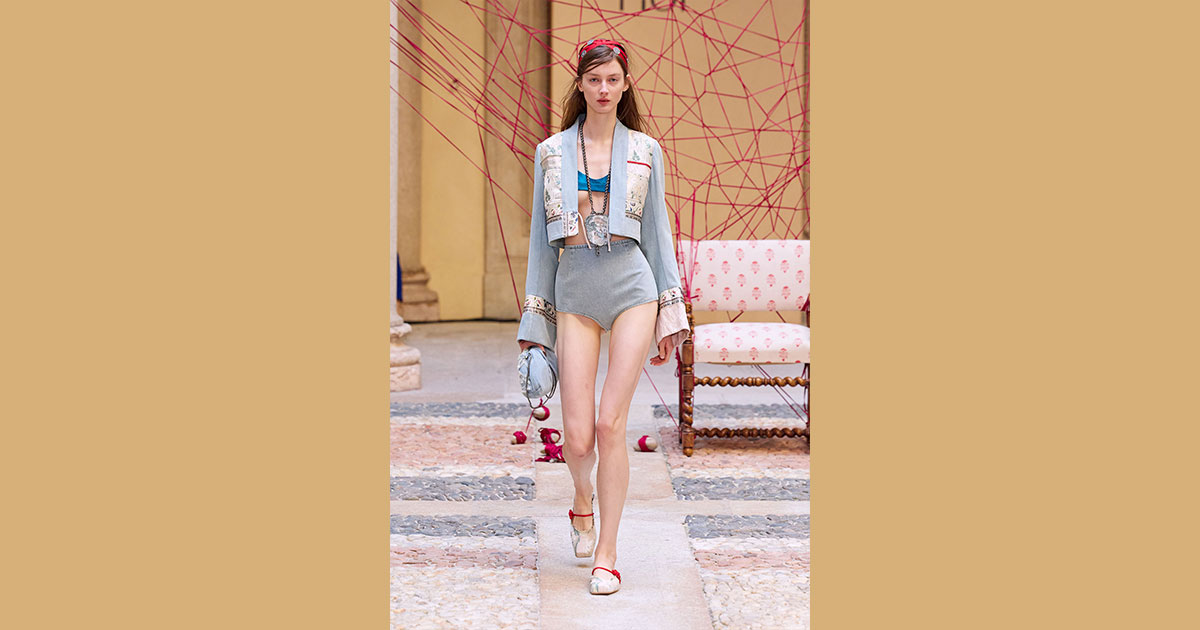
MILAN – An opening fan, a web of red threads, the courtyard of an ancient Italian building and a Western woman moving slowly through the space. Even before the first look appeared, HUI Milano had already made the direction of its Spring/Summer 2027 collection clear.
On the morning of Sunday, September 27, during Milan Fashion Week, the brand founded by Huizhou Zhao presented THE FAN CODE, a collection built around the relationship between East and West, past and present, memory and transformation.
The starting point is the circular fan, an object deeply rooted in Chinese culture. For HUI, however, it does not become something to be reproduced literally on clothing. Instead, it serves as a key—a first clue leading into a much broader story.
A Fan as a Gateway into Chinese Culture
The runway show opened with a performance designed to introduce that journey.
A Western woman encountered a web of red threads stretched across the space. As she moved through them and followed their paths, she gradually developed a relationship with the fan, while the threads became a metaphor for time, memory and the connections between different cultures.
When the final thread was released and the fan fully unfolded, the music shifted as well. The first model then appeared, and the symbolic narrative gave way to the runway.
This was not a nostalgic reconstruction of China, but rather a question about what remains alive within a culture when it passes through new generations, new places and new forms of expression.
Women as Keepers and Interpreters of Memory
One of the strongest themes of THE FAN CODE is the role of women in cultural transmission.
HUI Milano looked in particular to the Miao women of Guizhou, communities in which weaving, embroidery, dyeing and sewing have long served as ways of passing down collective memory, identity and knowledge.
But Huizhou Zhao’s interpretation does not freeze that tradition in the past.
The Eastern woman portrayed by the collection is not a symbolic figure tasked simply with preserving what came before. She is an active participant, free to inherit, transform, preserve or choose something new.
That is precisely where the collection moves away from the idea of tradition as something untouchable.
For HUI, culture remains alive because someone practices it, wears it and changes it.
Silk, Sheer Fabrics and More Structured Silhouettes
On the runway, this idea was translated through materials, proportions and surfaces.
References to Chinese culture were fragmented and reassembled, rather than applied to the garments in an overly literal way. Motifs, colors, historical imagery and traces of craftsmanship were incorporated into contemporary silhouettes, where the past remained visible without simply being reproduced.
The collection alternated printed silk, translucent materials and more structured fabrics.
The silhouettes continuously played with opposites: softness and construction, transparency and coverage, movement and precision.
It is this balance that keeps the collection from feeling like costume. Cultural heritage is not displayed as something to be observed from a distance, but transformed into something meant to be worn today.
Huizhou Zhao’s Vision of the East
Behind this vision is Huizhou Zhao, founder and designer of the brand and ambassador of China Style in Italy.
For years, her work has centered on the dialogue between Chinese culture and the international fashion system, searching for a perspective that does not reduce the East to its most immediately recognizable symbols.
In THE FAN CODE, that research becomes especially clear.
The fan is only the starting point. The true “code” of the collection is built through a sequence of elements: a color, a motif, a gesture, a fabric, a silhouette.
None of these elements alone attempts to explain Chinese culture. Together, however, they create an image of a contemporary East that preserves its roots while continuing to generate new meanings.
A Tradition That Refuses to Stand Still
The central question of the show, then, is not only about aesthetics.
It is about the way culture is passed down.
HUI Milano begins with the idea that cultural heritage does not necessarily need to remain identical to itself in order to stay authentic. It can move through new bodies, new materials and new contexts without losing its origins.
From this perspective, the craftsmanship of the Miao women and the contemporary work of the designer belong to the same process: both keep memory alive through creation.
Fashion becomes the place where that transformation can be seen.
“The East Does Not Reveal Itself All at Once. It Unfolds.”
The phrase chosen by HUI Milano to accompany the collection—“The East does not reveal itself all at once. It unfolds.”—captures the meaning of the entire project.
The East is not presented as a fixed image, but as something that reveals itself gradually.
Just like the fan in the opening performance.
First closed, then crossed by the threads of memory, and finally opened before the audience.
It is in that gesture that THE FAN CODE perhaps finds its clearest image: a culture that is not simply preserved, but continues to open, evolve and tell its story through the people who still live it today.
With Spring/Summer 2027, HUI Milano brings to Fashion Week a vision in which Chinese heritage is neither nostalgia nor decoration.
It is something alive.
Alla Milano Fashion Week, Huizhou Zhao presenta la Primavera/Estate 2027 partendo da un simbolo antico, il ventaglio circolare, per raccontare memoria, identità femminile e trasformazione della cultura cinese.
MILANO – Un ventaglio che si apre, una trama di fili rossi, il cortile di un antico palazzo italiano e una donna occidentale che attraversa lentamente lo spazio. Prima ancora che comparisse il primo look, HUI Milano aveva già chiarito la direzione della sua Primavera/Estate 2027.
La mattina di domenica 27 settembre, durante la Milano Fashion Week, il brand fondato da Huizhou Zhao ha presentato THE FAN CODE, una collezione costruita intorno al rapporto tra Oriente e Occidente, passato e presente, memoria e trasformazione.
Il punto di partenza è il ventaglio circolare, elemento profondamente legato alla cultura cinese. Ma per HUI non diventa un oggetto da riprodurre letteralmente sugli abiti. È piuttosto una chiave d’accesso, il primo indizio di un racconto più ampio.
Un ventaglio per entrare nella cultura cinese
La sfilata si è aperta con una performance pensata proprio per introdurre questo percorso.
Una donna occidentale si è trovata davanti a una rete di fili rossi tesa nello spazio. Attraversandoli e seguendone il percorso, ha costruito progressivamente una relazione con il ventaglio, mentre i fili diventavano metafora del tempo, della memoria e dei collegamenti tra culture differenti.
Quando l’ultimo filo si è aperto e il ventaglio è stato finalmente dispiegato, anche la musica ha cambiato ritmo. A quel punto è comparsa la prima modella e il racconto simbolico ha lasciato spazio alla passerella.
Non una ricostruzione nostalgica della Cina, dunque, ma una domanda su ciò che di una cultura rimane vivo quando viene attraversato da nuove generazioni, nuovi luoghi e nuovi linguaggi.
Le donne come custodi e interpreti della memoria
Uno dei temi più forti di THE FAN CODE riguarda il ruolo delle donne nella trasmissione culturale.
HUI Milano ha guardato in particolare alle donne Miao del Guizhou, comunità nelle quali tessitura, ricamo, tintura e cucito hanno rappresentato nel tempo strumenti attraverso cui tramandare memoria collettiva, identità e conoscenze.
Ma la lettura proposta da Huizhou Zhao non immobilizza questa tradizione nel passato.
La donna orientale raccontata dalla collezione non è una figura simbolica incaricata semplicemente di custodire ciò che è stato. È una protagonista attiva, libera di ereditare, modificare, conservare oppure scegliere qualcosa di nuovo.
Ed è proprio qui che la collezione prende distanza dall’idea di tradizione come repertorio intoccabile.
Per HUI, una cultura continua a vivere perché qualcuno la pratica, la indossa, la cambia.
Seta, trasparenze e costruzioni più rigorose
Sulla passerella, questa idea è stata tradotta attraverso materiali, proporzioni e superfici.
Riferimenti alla cultura cinese sono stati frammentati e ricomposti, invece di essere riportati sugli abiti in maniera didascalica. Motivi, colori, immagini storiche e lavorazioni artigianali entrano così in silhouette contemporanee, dove il passato rimane riconoscibile ma non viene semplicemente replicato.
La collezione alterna seta stampata, materiali traslucidi e tessuti più strutturati.
Le forme giocano continuamente sugli opposti: morbidezza e costruzione, trasparenza e copertura, movimento e rigore.
È proprio questo equilibrio a evitare l’effetto costume. L’eredità culturale non viene esposta come qualcosa da osservare a distanza, ma trasformata in materia da vestire oggi.
L’Oriente secondo Huizhou Zhao
Dietro questa visione c’è il percorso di Huizhou Zhao, fondatrice e designer del marchio e ambasciatrice del China Style in Italia.
Il suo lavoro si sviluppa da anni intorno al dialogo tra cultura cinese e sistema internazionale della moda, cercando una posizione che non riduca l’Oriente ai simboli più immediatamente riconoscibili.
In THE FAN CODE questa ricerca diventa particolarmente evidente.
Il ventaglio è soltanto il punto di partenza. Il vero “codice” della collezione si costruisce attraverso una sequenza di elementi: un colore, un motivo, un gesto, un tessuto, una silhouette.
Nessuno di questi da solo pretende di spiegare la cultura cinese. Insieme, però, compongono l’immagine di un Oriente contemporaneo che conserva le proprie radici e continua, nello stesso tempo, a produrre significati nuovi.
Una tradizione che non vuole restare ferma
La questione centrale della sfilata non riguarda quindi soltanto l’estetica.
Riguarda il modo in cui una cultura viene trasmessa.
HUI Milano parte dall’idea che il patrimonio culturale non debba necessariamente essere conservato identico a se stesso per rimanere autentico. Può attraversare nuovi corpi, nuovi materiali e nuovi contesti senza perdere la propria origine.
In questa prospettiva, il gesto artigianale delle donne Miao e il lavoro contemporaneo del designer appartengono allo stesso processo: entrambi tengono viva una memoria attraverso la creazione.
E la moda diventa il luogo in cui questa trasformazione può essere visibile.
“The East does not reveal itself all at once. It unfolds”
La frase scelta da HUI Milano per accompagnare la collezione — “The East does not reveal itself all at once. It unfolds” — sintetizza bene il senso dell’intero progetto.
L’Oriente non viene presentato come un’immagine già definita, ma come qualcosa che si scopre progressivamente.
Esattamente come il ventaglio della performance iniziale.
Prima chiuso, poi attraversato dai fili della memoria e infine aperto davanti al pubblico.
È in quel gesto che THE FAN CODE trova forse la sua immagine più chiara: una cultura che non viene semplicemente conservata, ma continua ad aprirsi, cambiare e raccontarsi attraverso le persone che ancora oggi la vivono.
Con la Primavera/Estate 2027, HUI Milano porta così alla Fashion Week una visione in cui il patrimonio cinese non è nostalgia e non è decorazione.
È materia viva.